This site is supported by our readers. We may earn a commission, at no cost to you, if you purchase through links.
A ball python can sit on a warm side that reads 90°F on the air probe and still go hungry, because the rock under its belly is 10°F cooler than the air above it. Snakes respond to surface heat, not the number on your thermometer.
That gap explains why so many first-time keepers misjudge their setups. Each species needs its own range, and the best temperature for different snake breeds shifts between a ball python, a corn snake, and a boa. The wrong reading can mean stalled digestion or a burn.
Here’s how to set up each zone correctly.
Table Of Contents
- Key Takeaways
- Best Temperature Ranges for Common Pet Snake Species
- Creating Warm and Cool Zones in Your Snake’s Enclosure
- Safe Heat Sources and Thermostat Control for Snake Enclosures
- Measuring Ambient Air and Basking Surface Temperatures
- Managing Nighttime Temperatures and Preventing Unsafe Extremes
- Frequently Asked Questions (FAQs)
- Are snakes out in 100 degree weather?
- Is 72 degrees too cold for a ball python?
- Is 90 degrees too hot for a snake?
- Can snakes be out in 50 degree weather?
- What is the ideal temperature range for a ball python’s habitat?
- How should I create a temperature gradient in my ball python’s enclosure?
- How important is maintaining proper humidity for ball pythons?
- Should I use UVB lighting in my ball python’s enclosure?
- How can I ensure safe temperatures for my ball python’s enclosure?
- What temperature do snakes like best?
- Conclusion
Key Takeaways
- Measure the surface where your snake actually rests with an infrared thermometer, because air readings can run about 10°F off and hide cold floors or hot spots.
- Your target temperatures depend on the species: ball pythons need a warm side of 88–92°F, corn snakes about 85°F, and boas 85–88°F, each with a cooler side at least 10°F lower.
- Run every heat source through a thermostat with the probe taped to the warm-side surface, since overheating hurts a snake faster than a cool enclosure does.
- Let nights drop about 5°F, add a non-light-emitting heater like a ceramic emitter if your room gets cold, and never let the enclosure fall below 60°F.
Best Temperature Ranges for Common Pet Snake Species
Every snake species has its own comfortable temperature range, and getting it right is the first step toward a healthy animal. Below, you’ll find the ambient and basking targets for three of the most popular pet species. Use them as your starting point, then confirm each reading with your own thermometers.
Because humidity affects shedding and respiratory health just as much as heat does, it helps to check the ideal temperature and humidity for pet snakes before you set up the enclosure.
Ball Python Temperatures
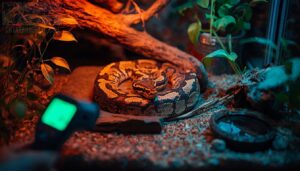
Most keepers find the ideal temperature range for a Ball Python is 88–92°F on the warm side and 76–80°F on the cool side. Keep ambient air below 95°F to avoid overheating.
Your basking spot should read roughly 90–95°F on the surface, measured with an infrared thermometer. Make sure every heat source is thermostat-controlled, because you can’t safely rely on guesswork. Offering a proper thermal gradient lets your snake regulate its own body temperature by moving between the warm and cool zones.
Corn Snake Temperatures
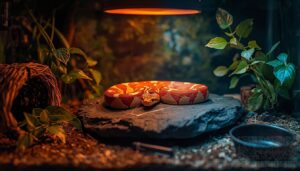
A Corn Snake runs cooler than a Ball Python. The ideal temperature range is 85°F on the warm side and 75°F on the cool side, creating a proper temperature gradient.
- Keep surface basking temperatures at 88–90°F.
- Aim for nights of 70–75°F across the enclosure.
- Never let adults drop below 65°F.
- Keep juveniles above 75°F overnight.
- Use thermostats with warm-side probes.
Boa Constrictor Temperatures
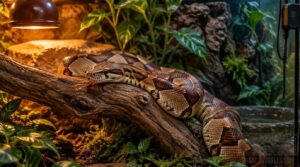
A Boa Constrictor needs slightly more heat than a Corn Snake. Build a Temperature Gradient with a warm side of 85–88°F and a cool side of 75–80°F. Keep Basking Temperatures at 88–92°F, the Preferred Ideal Temperature Zone for digestion.
Since young boas lose heat faster than adults, a properly sized heating pad for snakes helps you hold that warm side steadily without overheating the enclosure.
Central American boas tolerate cooler conditions, so you can lower the warm side to 80–85°F. Keep heaters Thermostat Controlled to prevent overheating.
Creating Warm and Cool Zones in Your Snake’s Enclosure
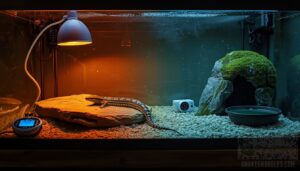
Once you know your species’ targets, you need to build them into the enclosure. A snake regulates its body heat by moving, so your job is to create a temperature gradient it can move through.
Placing your heat source at one end and adding hides on both sides makes the gradient work, and building a naturalistic terrarium shows how to do it while keeping the setup looking good.
Place the heat source at one end, about 6 inches from the sidewall, so warmth spreads evenly along the floor. This enclosure zoning gives you a basking spot at one end and a cool zone at the other.
Check three things:
- Measure the surface where your snake rests, not the air, since readings can differ by 10°F.
- Keep at least a 10°F difference between warm and cool probes.
- Use a thermostat-controlled heat source so the warm end stays stable.
A smaller gap suggests poor placement.
Safe Heat Sources and Thermostat Control for Snake Enclosures
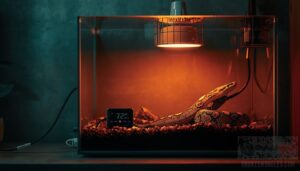
You should run every heating device through a thermostat, because overheating hurts snakes faster than a cool enclosure does. Heat source safety starts there, and it’s the rule you can’t skip.
Run every heater through a thermostat, because overheating harms a snake faster than a cool enclosure ever will
Choose thermostat-controlled undertank heaters for ball pythons and corn snakes, and use ceramic heat emitters or radiant heat panels for larger setups.
Since heat pads vary a lot in size, wattage, and build quality, this guide to choosing the right ball python heating pad can help you match one to your enclosure.
| Heat source | Best for | Risk without control |
|---|---|---|
| Undertank heaters | Ball pythons, corn snakes | Belly burns |
| Ceramic heat emitters | Boas, large enclosures | Dangerous overheating |
| Radiant heat panels | Tall enclosures | Hot spots |
| Heat lamps | Basking areas | Contact burns |
Add a pulse-width modulation unit like the Inkbird ITC-308, and tape the probe to the warm-side surface so your snake can’t move it. Choose UL-listed gear, and check cables for fraying.
Measuring Ambient Air and Basking Surface Temperatures
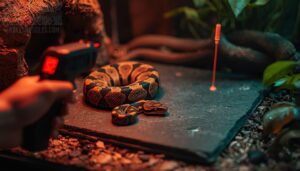
How do you know your snake’s enclosure is truly safe? Start by separating two readings that people often confuse: ambient air and basking surface temperatures.
Digital thermometers with probes measure ambient air, while an infrared thermometer reads the basking surface directly. Standard dial thermometers usually give poor surface data, so don’t rely on them.
- Place the air probe in shade on the cool side, away from heat sources.
- Keep probes off substrate and decor so conduction doesn’t skew results.
- Aim the infrared thermometer at the basking rock or slab, targeting about 90°F for Ball Pythons.
- Measure both ends to confirm your temperature gradient.
- Check probe placement daily, since snakes can dislodge them.
Expect surface readings to run higher than air.
Managing Nighttime Temperatures and Preventing Unsafe Extremes
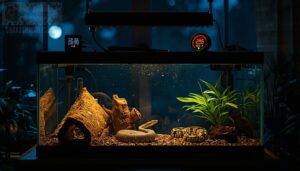
Your snake needs warmth to digest, but it also needs a break from that warmth after dark. Nighttime temperatures should drop about 5°F from daytime highs, which is natural and healthy for most species.
For ball pythons, aim for 72-76°F on the cool side. Corn snakes handle nights near 75°F, though hatchlings need warmer conditions. If your room falls below 60-68°F, add a non-light-emitting heat source, such as a ceramic heat emitter or radiant panel. Skip colored bulbs, since they can disrupt circadian rhythms.
Keep every heater thermostat-controlled, and check digital thermometers at both ends daily, because probes can drift. Good temperature monitoring helps avoid heat stress. Plan backup heating during outages, and never let the enclosure drop below 60°F.
Frequently Asked Questions (FAQs)
Are snakes out in 100 degree weather?
Wondering if snakes stay out when it hits 100°F? Mostly, no. Heat stress avoidance kicks in above 90°F, so they retreat to shade and burrows, and heat stroke becomes a real risk without it.
Is 72 degrees too cold for a ball python?
The claim that 72°F is harmless is partly true. Ball pythons tolerate it briefly on the cool side, but prolonged exposure raises risks. Use a thermostat to hold basking temperatures in the ideal temperature range.
Is 90 degrees too hot for a snake?
A ball python’s warm side usually runs 88 to 92°F, so 90°F is often right. But a temperature gradient matters more than one number. Use thermostats, confirm your ideal temperature range per species, and keep cooling methods ready.
Can snakes be out in 50 degree weather?
If your ball python’s cool side drops to 50°F overnight, that’s too cold. Snakes can’t warm themselves, so those nighttime temperatures break the temperature gradient.
Use temperature monitoring tools and watch for temperature stress symptoms.
What is the ideal temperature range for a ball python’s habitat?
The ideal temperature range for a ball python is 88-92°F on the warm side and 76-80°F on the cool side. This temperature gradient helps reptiles regulate their body temperature, and a thermostat keeps your heat source safe.
How should I create a temperature gradient in my ball python’s enclosure?
Heat one end to build your temperature gradient. A thermostat-controlled mat under a third of the floor creates a basking area.
Keep the warm side 88-92°F, the cool side 74-80°F.
Once the temperatures are right, a shy snake will settle faster if you follow these ball python trust-building methods and keep handling sessions short, calm, and consistent.
If your snake still seems sluggish or refuses to eat, learn the warning signs of a snake that has gotten too cold and how to warm it up safely.
Add hides at both ends.
How important is maintaining proper humidity for ball pythons?
Humidity matters for ball pythons. Keep it at 50-60% to support shedding, hydration and breathing.
In your enclosure setup, pair a thermostat-controlled heat source with ventilation and humidity balance, within the preferred ideal temperature zone.
Should I use UVB lighting in my ball python’s enclosure?
Snakes have survived millions of years without your lighting advice. UVB lighting isn’t essential, but a low-output tube over the basking area may help. Keep your thermostat and thermal gradient in the ideal temperature range.
How can I ensure safe temperatures for my ball python’s enclosure?
Use a thermostat, probe in the warm hide, and check enclosure temperature zoning with digital probe thermometers. Keep the basking surface at 88–92°F and the cool side temperature range at 76–80°F, creating a temperature gradient.
What temperature do snakes like best?
Snakes don’t prefer one temperature. Thermoregulation in reptiles means they move between a warm and cool thermal gradient, using basking spots as needed. Your snake’s ideal temperature range depends on species-specific care, so offer choices.
Conclusion
You might think a cheap thermometer and a heat lamp are enough. They aren’t, because air readings alone hide cold floors and hot spots.
Once you know the best temperature for different snake breeds, your job is to deliver it where the snake actually lives: on the surface, in a gradient, controlled by a thermostat.
Check your readings with a temp gun this week. Then watch your snake. Steady digestion means you got it right.