This site is supported by our readers. We may earn a commission, at no cost to you, if you purchase through links.

A single kingsnake species can call soggy Louisiana marshland and bone-dry Sonoran scrubland home, sometimes within the same generation of a spreading population. That range of tolerance sets kingsnakes apart from most North American colubrids, which tend to specialize and stay put.
You’ll find them from southern Ontario’s prairie fringe down through Ecuador’s Andean foothills, adapting their microhabitat selection to whatever rocks, root mats, or rodent burrows the local terrain offers. Understanding where and why they settle tells you a lot about their notable physiological flexibility.
This guide walks through the geography, climate patterns, and shelter types that define king snake natural habitat information, from pine woodlands to your own backyard.
Table Of Contents
- Key Takeaways
- Where Do King Snakes Live?
- Natural Habitats King Snakes Prefer
- Microhabitats Used for Shelter and Hunting
- How Climate Shapes King Snake Habitat
- Human-Altered Habitats and Conservation Threats
- Frequently Asked Questions (FAQs)
- What is a king snakes natural habitat?
- Is it good to have a king snake in your yard?
- Are king snakes aggressive?
- Do king snakes stay in one area?
- Do king snakes hibernate during winter months?
- Can king snakes swim in water effectively?
- How do king snakes choose nesting sites?
- What temperature ranges do king snakes prefer?
- Do king snakes return to same territories?
- How long do king snakes typically live?
- Conclusion
Key Takeaways
- Kingsnakes are found from southern Ontario down through Ecuador, thriving in deserts, wetlands, forests, and prairies alike thanks to their unusual adaptability among North American snakes.
- Temperature drives their behavior directly: they bask in the 24–30°C range, switch to nighttime hunting when it gets too hot, and brumate in underground shelters 15–60 cm deep once temps drop below 60°F.
- Micro-level shelter choices, like rocky crevices, rodent burrows, and log piles, matter as much as broad habitat type, since these spots offer stable temperatures and easy access to prey.
- Human development is a double-edged sword, kingsnakes readily use barns, gardens, and roadsides for hunting and shelter, but habitat fragmentation and road mortality have already wiped out up to 40% of usable range in some regions.
Where Do King Snakes Live?
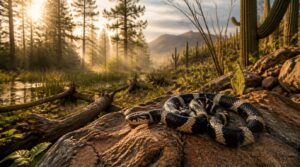
King snakes cover an astonishing amount of ground across the Americas, and their range says a lot about how adaptable they really are. You won’t find one single answer to where they live, since distribution shifts by region and species. Here’s a breakdown of exactly where these snakes call home.
For a closer look at how far this range actually stretches, this interactive king snake habitat map breaks down their territory region by region.
Range Across The United States
If you want to grasp just how adaptable king snakes really are, start with the map. Their geographic range stretches from the Northeast Atlantic Range down through the Southeast Gulf Range, across the Midwest Plains Range, into the Rocky Mountain Range, and out to the Pacific Coast Range.
- Deserts baking under triple-digit sun
- Humid pine woodlands dripping with dew
- Suburban gardens tucked beside highways
- Farmland stretching toward the horizon
That kind of habitat flexibility shows up across wildly different temperature ranges, from sea level to nearly 8,000 feet.
Southern Canada Range Limits
That coast-to-coast flexibility fades fast once you head into southeastern Canada. Cold winters push the northern edge back to southern Ontario and the prairie fringe, rarely crossing the 50th parallel.
You’ll find survival tied to river valley dispersal and microclimate refuges, like sunlit escarpments, where winter brumation sites in rock crevices make the difference between a population persisting or vanishing.
Mexico and Central America
South of that Ontario refuge, king snakes hit their stride. You’ll find them across Sonora’s desert scrub, Baja California populations, and Yucatan’s tropical forests, thriving in the Sonoran Desert habitats and thorn scrub alike.
Guatemala’s transitional forest edges and western Panama’s dry forests show notable habitat flexibility, while cloud forest dwellers mark rich species richness zones worth preserving. This diversity is aided by the region’s varied volcanic soil formations, which support the highly productive highland ecosystems these snakes depend on.
Northern South America Records
Head further south and the range keeps stretching, all the way into northern Ecuador.
Amazon basin habitats and Andean foothill zones both hold documented records, with riparian corridor use along major rivers and leaf litter foraging supporting scattered populations.
Deforestation impact zones are reshaping habitat suitability here, which is why species distribution modeling matters for tracking this shifting geographic range.
Regional Species Distribution
Zoom into any single state and you’ll notice subspecies range boundaries rarely line up neatly, creating coastal inland overlap and dense river valley concentrations.
Population density shifts county to county based on prey and cover.
Imagine this snapshot:
- Florida’s pinelands
- Texas brushlands
- California’s coastal scrub
- Great Plains grasslands
Cross-border movement between these zones sustains regional species coexistence and habitat connectivity.
Species like king snakes depend on these overlapping ranges to find the drier, warmer microclimates they need, a dynamic explored further in this guide to snake health and behavior.
Natural Habitats King Snakes Prefer
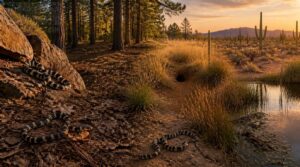
King snakes aren’t picky regarding real estate, and that adaptability is exactly what makes them such successful survivors. You’ll find them thriving across a notable range of landscapes, each one shaping how they hunt, hide, and stay cool. Here’s a look at the five habitat types where they turn up most often.
Forests and Pine Woodlands
Pine woodlands offer king snakes an ideal mix of shelter and hunting ground. You’ll find open canopy density letting sunlight reach the understory, where grasses and shrubs thrive.
Fire regimes keep litter low and encourage fire-adapted pines like longleaf. Fallen logs and needle litter create cover, while diverse tree species composition helps sustain the rodents and reptiles kingsnakes hunt across their forest range.
Beneath these fire-maintained pine floors, burrowing snakes act as underground ecosystem engineers, aerating soil in ways that indirectly support the same prey base kingsnakes depend on.
Grasslands and Prairies
Big bluestem and Indian grass stretch across the open prairie, their deep roots locking carbon into rich soil. Periodic prairie fire ecology and bison grazing patterns kept woody plants back, favoring the low cover kingsnakes hunt through.
Drought-adapted root systems anchor this geographic range, giving snakes reliable habitat connectivity even as climate change reshapes seasonal rainfall.
Deserts, Scrublands, and Chaparral
How does a snake survive where daytime highs top 35°C and rain barely reaches 30 cm a year? Desert heat tolerance kicks in: kingsnakes shift to nocturnal foraging, seeking shade and burrows.
In chaparral’s fire-adapted shrubs, they exploit post-burn rodent booms. Rocky crevices and dense scrub offer shelter, while rainfall-driven activity pulses hunting after seasonal rains across this arid geographic range.
Wetlands, Marshes, and Estuaries
Where does a hunting kingsnake head after the rains? Straight for the marsh edge. Wetland prey abundance draws them into cattail stands and riparian zones, hunting frogs and rodents along muddy banks.
Estuaries offer brackish transitions where salt marsh adaptation matters less to kingsnakes than to their prey, still, these near-water habitats and sunny marsh basking sites stay reliably productive hunting grounds.
Rocky and Mountainous Terrain
Ever wonder why a kingsnake vanishes into a cliff face? Rocky crevice shelter explains it, offering stable microclimate adaptation.
You’ll find high elevation basking on sunlit slabs, slope thermoregulation between rocks, and cliff face hunting for lizards. Rocky outcrops across their geographic range show real habitat stratification, useful data for ecological niche modeling of alpine foraging zones.
Microhabitats Used for Shelter and Hunting
Zoom in past the broad habitat type, and you’ll find king snakes are picky about the exact spot they choose. Every successful hunt or safe night’s rest comes down to a handful of go-to microhabitats. Here’s what to look for on the ground.
Rocky Crevices and Rodent Burrows
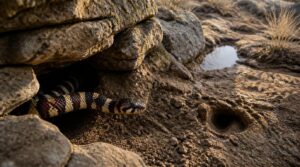
Where rock meets soil, king snakes find their best real estate. Rocky crevices (5–40 cm deep) offer predator escape routes and stable microclimate regulation, staying 18–28°C year-round.
You’ll find them linking to rodent burrows nearby, exploiting burrow network access to ambush prey underground.
Seasonal movement shifts push snakes toward water-filled crevices after rains, reshaping their travel corridors between outcrops and hunting grounds.
Logs, Leaf Litter, and Brush
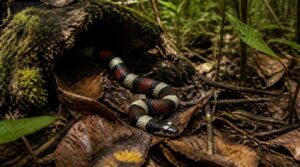
Beyond rock and burrow, fallen logs shelter king snakes in hollow cores holding steady humidity. Decaying wood draws rodents and insects, prime foraging ground. Leaf litter insulates the forest floor, hiding lizards and aiding sheds.
- Hollow logs for cover
- Leaf litter foraging
- Brush ambush points
- Moist microhabitat pockets
Dense brush creates shaded, prey-rich corridors linking these terrestrial habitats.
Basking Clearings and Cool Retreats
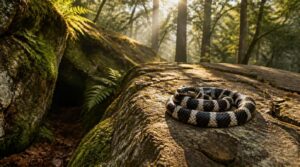
Once you leave leaf litter behind, you’ll find king snakes seeking out sunlit clearings, 5 to 20 square meters, for thermal refuge zones. They bask 30-60 minutes at 70-90°F, then retreat to shaded, humid pockets nearby.
This clearing-to-retreat corridor creates habitat stratification, letting snakes regulate temperature efficiently while staying alert near rocky outcrops.
Moist Refuges Near Water
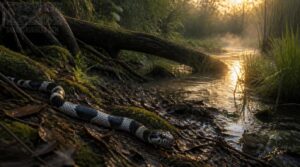
Not every retreat is dry. Along slow streams, you’ll find mossy banks holding constant humidity, perfect for humidity-dependent foraging.
Reed beds and cattail stands shelter amphibians and small fish, while fallen logs and root mats create cool, moist microclimates.
Sedge clumps and shallow-water pockets round out these riparian zones, boosting habitat suitability for nocturnal hunters.
Prey-Rich Edges and Corridors
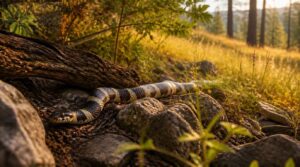
Where two habitats meet, hunting gets easier. Edge prey density climbs as hedgerows draw rodents and lizards into reliable reach.
You’ll find corridor foraging paths linking refuges, with sunlit and shaded patches aiding thermoregulation mid-chase.
These habitat linkage zones support seasonal prey pulses, fruiting trees and post-fire regrowth, boosting habitat suitability wherever wildlife corridors connect fragmented ground.
How Climate Shapes King Snake Habitat
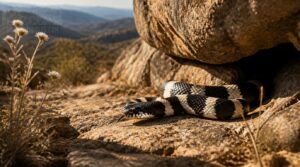
Temperature drives nearly every decision a king snake makes, from when it hunts to where it hides. You’ll find that these snakes are surprisingly responsive to heat, cold, and elevation, adjusting their behavior to match. Here’s what shapes their daily and seasonal rhythms across different climates.
Preferred Activity Temperatures
Ectotherms live and die by the thermostat outside their bodies. King snakes seek 24 to 30°C microhabitats for daytime activity, basking on sunlit rocks until they hit 28-34°C internally.
- Sun-warmed stones for quick heat gain
- Shaded burrows for cooling off
- Rocky slopes holding heat briefly
- Forest clearings for steady warmth
- Grassland patches offering flexible thermoregulation
Elevation matters too: valley floors run hotter than mountain slopes.
Nocturnal Shifts During Extreme Heat
When temperatures climb past 90°F, you’ll see king snakes flip their whole schedule. This heat avoidance behavior pushes hunting into darkness, when 70°F+ nights slash road exposure and sharpen scent-based prey tracking.
Cooler air allows longer nocturnal foraging shifts, letting snakes exploit rodents and amphibians drawn out after sunset while resting in shaded, thermally stable cool microclimate retreats until dawn.
Elevation and Regional Climate
Climb a mountainside and you’ll feel the shift yourself: cooler air, sharper winds, shorter basking windows. King snakes read these thermal mosaics too, using rocky outcrops for elevation-driven thermoregulation.
Desert basins concentrate rodents near water, while montane forests favor lizards. Climate zones from arid lowlands to humid highlands shape regional prey availability, seasonal movement, and where populations settle across their geographic range.
Winter Brumation Shelter Needs
Winter demands more than a hiding spot. You’ll find king snakes selecting subterranean retreats offering real insulation, 15 to 60 centimeters deep, where soil provides thermal buffering near 5 to 10°C.
Key needs:
- Predator-protected entrances
- Moisture control (damp, not wet)
- Stable brumation temperature range
- Insulation against frost heave
Habitat suitability index rises wherever these factors align.
Year-Round Activity in Warm Regions
Not every kingsnake shuts down for winter. In mild climates like Southern California, you’ll see year-round activity, with brief dormancy instead of true brumation.
Prey pulse tracking keeps foraging steady above 60°F, while shelter-seeking behavior and thermal refuge use handle midday heat.
Juvenile dispersal timing shifts earlier too, since warm microclimates favor consistent growth without winter’s hard stop.
Human-Altered Habitats and Conservation Threats
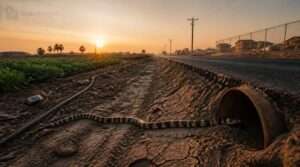
King snakes don’t stop at forests and deserts—they’ve learned to work with the spaces you create. That adaptability comes with real risks, though, ones tied directly to how we build and farm and drive. Here’s where you’ll find them living alongside people, and what’s putting them in danger.
Farms, Barns, and Outbuildings
Where crops meet cover, kingsnakes thrive. Barn structures, hay stacks, and machinery sheds offer rodent-rich hunting grounds and shelter alike.
You’ll find them coiled beneath wood piles or tucked into stone walls near farm outbuildings. This habitat overlap between agricultural buildings and wild terrain creates ideal rural shelters, blending prey access, cover, and stable microclimates kingsnakes rely on year-round.
Backyards, Gardens, and Suburbs
Farm fields aren’t the only human-altered ground kingsnakes claim. Your own backyard can double as a wildlife corridor, especially with hedgerows, brush piles, and native plants.
Layering tall oaks and maples over shrubs and groundcover mimics a natural habitat, and this guide to creating a natural habitat for snakes shows how.
You’ll boost residential prey availability just by:
- Leaving leaf litter and log piles as shelter
- Planting native species to draw in rodents and lizards
- Adding fence gaps for suburban habitat connectivity
Roadsides and Abandoned Structures
Past the garden fence, roads and ruins become your next wildlife corridor. Grassy shoulders concentrate rodents, so kingsnakes forage the edges, then vanish under collapsed boards or rubble for abandoned shelter use.
| Feature | Benefit | Risk |
|---|---|---|
| Sunny pavement | Fast basking | Vehicle strikes |
| Debris piles | Cool retreat | Chemical exposure |
| Grain spills | Rodent prey | Disturbance |
Habitat Loss and Fragmentation
Roadside foraging only works if habitat still surrounds it, and that’s shrinking fast. Southwestern ranges have lost up to 40 percent of usable habitat to farming and sprawl in three decades.
Fragmentation isolates populations, cutting genetic diversity and slowing recovery. Without wildlife corridors linking rock outcrops and woodlands, gaps over 500 meters exceed dispersal range, leaving edge effects to finish the damage.
Road Mortality and Chemical Exposure
When asphalt cuts through a snake’s range, danger follows. Vehicle collision risk peaks at dawn and dusk, while road runoff brings antifreeze, pesticides, and heavy metals into roadside soils. Add thermal stress from sun-baked pavement, and edges become mortality traps.
Where roads cut through their range, dawn and dusk turns pavement into a mortality trap for king snakes
Underpasses, barrier fencing, and vegetated buffers, paired with habitat restoration and wildlife corridors, offer real hope for kingsnakes moving through human-altered landscapes.
Frequently Asked Questions (FAQs)
What is a king snakes natural habitat?
Home is wherever cover meets prey: that’s the king snake’s rule of thumb. You’ll find these adaptable hunters across terrestrial habitats and near-water habitats alike, from rocky outcrops to farmland, wherever shelter and food overlap.
Is it good to have a king snake in your yard?
Yes. You’ll gain natural pest control, fewer rodents, and a venomous snake deterrent nearby. King snakes signal a healthy yard habitat and coexist safely with people and pets when left undisturbed in their habitat.
Are king snakes aggressive?
Not really. King snakes show mild temperament traits, favoring flight over fighting. Wild individuals may bite or musk defensively when cornered, but captive ones handle calmly.
Their instinct leans toward predator avoidance, not aggression, since energy’s better spent hunting prey than picking fights.
Do king snakes stay in one area?
Not exactly. You’ll find kingsnakes keep a small home range but shift within it, following prey-driven travel and seasonal activity shifts. Shelter fidelity is loose, individuals overlap ranges, moving through corridors as prey and weather change.
Do king snakes hibernate during winter months?
Not quite. King snakes brumate rather than hibernate, dropping their metabolism and relying on stored fat. Falling temperatures trigger this dormancy, and they’ll tuck into stable dens, staying still for weeks until warmth returns.
Can king snakes swim in water effectively?
Ever watched a snake vanish into a creek and wondered how it does it? King snakes swim with confident lateral undulation, wading near-water habitats to hunt amphibians or escape threats, even as hatchlings, right from birth.
How do king snakes choose nesting sites?
You’ll find females tucking eggs into rodent burrows or hollow logs, favoring humid, stable microclimates near prey-rich zones. This balances egg protection, moisture retention, and predator avoidance, giving hatchlings a hidden, temperature-buffered start.
What temperature ranges do king snakes prefer?
You’ll find king snakes favoring a warm basking zone near 85–90°F, a cooler retreat around 70–78°F, and safe nighttime lows of 65–70°F, with brumation triggered once temperatures dip below 60°F.
Do king snakes return to same territories?
Yes. Kingsnakes show strong site fidelity, revisiting main shelters and seasonal hunting grounds within their home range. Adults stay put in stable, prey-rich habitat, while juvenile dispersal covers greater distances before settling into their own territory.
How long do king snakes typically live?
In the wild, king snakes usually live 10 to 15 years, sometimes reaching Captive individuals often reach 20 to 30 years, since genetics, diet, and steady husbandry remove the environmental pressures wild populations face.
That extended lifespan also means females get more breeding cycles over time, and knowing how many times a year king snakes lay eggs can help owners plan for their care needs.
Conclusion
One kingsnake population can shift its range across four climate zones within a single decade, a pace few reptiles match. That statistic captures the heart of king snake natural habitat information: adaptability isn’t luck, it’s survival strategy.
From swamp edges to desert rock piles, these snakes read the land and settle where prey and shelter overlap. Learn their patterns, and you’ll spot them almost anywhere. Respect that astonishing flexibility, and you’ll understand exactly why kingsnakes endure.